
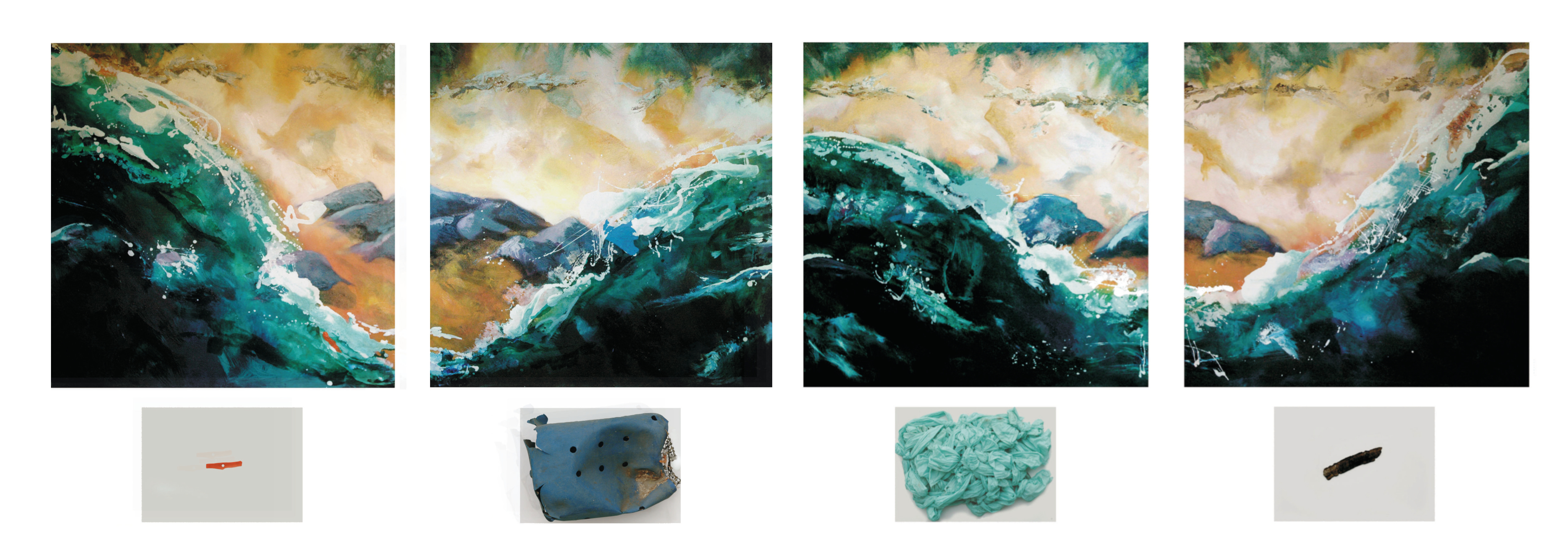


The following section explores the inspiration behind the work titled “Tidal Variations”, offering a reflection on natural rhythms, artistic interpretation, and philosophical questions about determinism and free will.
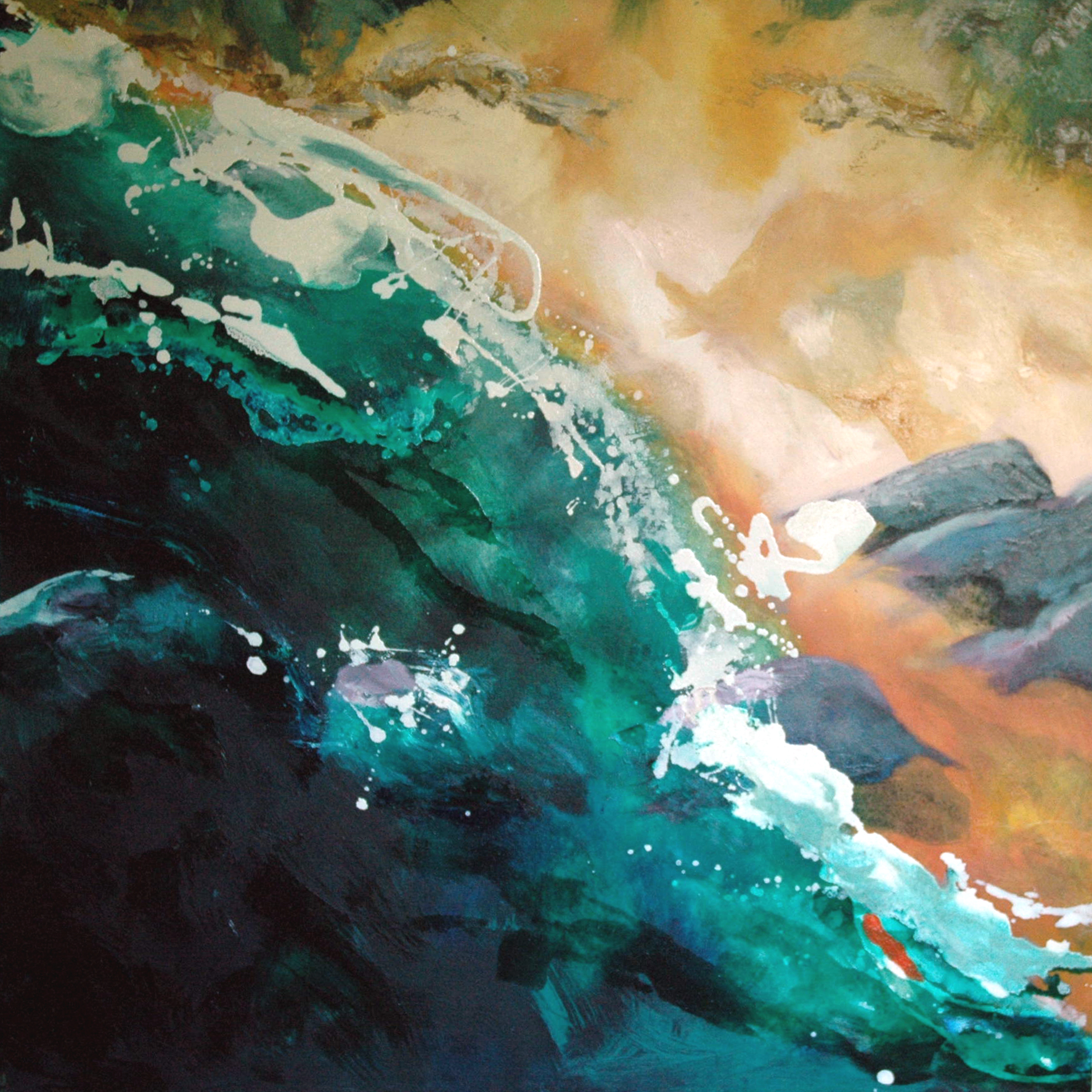
The shapes of the water’s edges in each of the four canvases are derived from a graph depicting an approximate 28-day repeating cycle of tidal variations. Tides ebb and flow twice daily; however, these cycles are slightly longer than a standard 24-hour period. This subtle difference means that tidal peaks and troughs occur a little later each day. Moreover, the height of each new tide is not consistent but varies depending on the alignment of the sun, the moon, and the earth. This pattern, repeating roughly every 28 days, is itself subject to minor variations with each cycle. It is important to note that this explanation is intentionally simplified and may contain inaccuracies, as it comes from the perspective of an artist rather than an oceanographer.
During this 28-day period on the Lincolnshire coast, four objects were retrieved from the beach—each washed ashore at a different time. Each canvas panel features one object, placed at the corresponding point in the tidal cycle when it was found. Each is marked by a small, randomly coloured area, unique to its panel.
In reflecting on these objects, the work considers the concept of determinism. Objects in water, moved by wind, current, and tide, are subject to scientific laws. Their movement is akin to that of snooker or pool balls: once struck, their paths are determined, and they cannot simply move at random. Regardless of the complexity of the system, if the objects were returned to their exact points of origin under the same conditions, they would follow the same trajectories and arrive at the same place.
This analogy extends to the human brain, which is as complex as the tidal system. Neurons transmit signals via electrical impulses, and both electricity and the atoms that comprise neurons are governed by deterministic scientific laws. This raises a fundamental question: if all our constituent parts are subject to these laws, is everything predestined? How, then, do we experience free will?
While there is a personal belief in the existence of free will and the capacity to make choices, the precise source of this freedom remains elusive—much like many other aspects of life.
 Malcolm Tait, Artist and Maker