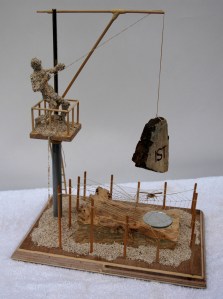
“Speech is a mirror of the soul: as a man speaks, so is he”.
The title for this piece of work is a quote by Publilius Syrus from approximately 100BC
Language is an integral part of my work this piece is the latest of many which explore different aspects of language.
“While names, words, and language can be, and are, used to inspire us, to motivate us to humane acts, to liberate us, they can also be used to dehumanize human beings and to ‘justify’ their suppression and even their extermination,”(1) Prof. Haig Bosmagiam
This work explores the oppressive nature of language in everyday conversation when we all defend our position of privilege within the societies we inhabit. Without a doubt some would seem to hold a disproportionate amount of privilege but we all enjoy some form of privilege over others, able bodied over the disabled, male over female, educated over uneducated are a few, things are improving but have still a way to go yet.
Language defines humanity, it sets us apart from all others species, some of whom with sound and body language can communicate powerful ideas and emotional feelings but the complexity of thought and knowledge that the human race has been able to harness and utilise through spoken language and the written word is remarkable.
What fascinates and challenges me is the breadth of possibility that language offers for inspiration or suppression as the orator so chooses. I find myself irked regularly at the put downs I come across in daily life, sometimes unintentionally but all too frequently with varying degrees of pleasure from the speaker.
This Festive season I have discovered the poem “Ulysses” [(1), see below] by Alfred Lord Tennyson, an inspiration to the older gentleman like myself when he says:
Come, my friends,
‘Tis not too late to seek a newer world.
Push off, and sitting well in order smite
The sounding furrows; for my purpose holds
To sail beyond the sunset, and the baths
Of all the western stars, until I die.
At the other end of this spectrum is the dehumasing language of war as recorded in Tim O’Brien’s award-winning novel The Things They Carried O’Brien writes, “By slighting death, by acting, we pretended it was not the terrible thing it was… If it isn’t human, it doesn’t matter much if it’s dead. And so a VC nurse fried by napalm, was a crispy critter. A Vietnamese baby, which lay nearby, was a roasted peanut. Just a crunchie munchie.” (2)
I find it hard to comprehend the use of such language, even allowing for the harrowing circumstances that combatants witnessed, lived through and had to deal with. The poet Paul Celan whose parents died in the Holocaust and himself interned in a work-camp from late 1942 till February 1944 in an acceptance speech illuminates the importance of language and the developing influence it continues to impart on us even through the darkest of circumstances;
“Only one thing remained reachable, close and secure amid all losses: language. Yes, language. In spite of everything, it remained secure against loss. But it had to go through its own lack of answers, through terrifying silence, through the thousand darknesses of murderous speech. It went through. It gave me no words for what was happening, but went through it. Went through and could resurface, ‘enriched’ by it all.” (3)
Stepping back from the extreme ends of the language spectrum within the web of language and meaning through the spoken word we have to discern what is part of the picture any orator wants to give and see through the way things are parts of any conversation which reveals their soul.
This is one aspect of a complex web of thoughts and ideas expressed through language, there are people who with great humility and compassion seek to help the disadvantaged but the very act of singling people out for help marks them out as different and it is so easy for them to be seen as “lesser” human beings, I do not for a second propose offering no help to anyone disadvantaged in any way but it is important that in doing so we include “others” in society and meet all as equals.
The Work:
I enjoy the fact that you can take a group of unrelated objects and explore a concept or idea. When we see objects we see them as the word that signifies them, we do not see a group of filaments spun by an arachnid between twigs, branches or plant material; we see a “web” and also its metaphoric possibilities and when we put disparate objects together that potential for exploration of ideas and metaphor seems to grow exponentially. What is always nice is that the ideas, language and metaphors explored are always the viewers but some of my own remain within the work for the viewer to enjoy or dismiss as they see fit.
The Objects:
The Letters on the Stone: The letters on the stone come from word endings the ” ISM” on one side comes from e.g. sexism, racism; they are the ideas and there expression in language, the “IST” alludes to the person the sexist, racist amongst others.
The Stone: used in various metaphors, “between a rock and a hard place”, “things being set in stone”, also the physical appearance of metaphorical weight it brings to the piece.
The section of wood which holds the mirror. This is the object which started the entire creation of this piece, found and brought to me because of its unusual appearance, it has lots of small pinnacles or nodes which reminds me of a bed of nails and is the “hard place” in between a rock and a hard place.
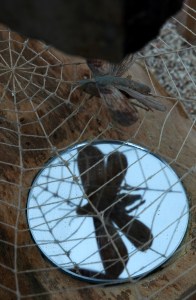
The Mirror: hints at whether we are looking at of hearing reality or perhaps a reflection of or distortion of what is alluded to.
The Web: references the complex nature of language and its use,
The Moth: caught on the web hints at the vagaries of language but also the fact that we are trapped in having to use language with its potential for being misconstrued, inaccurate, the potential for lies etc. etc but with the eternal search for “truth” whatever that may be.
The Sand: again its metaphorical properties are what interest me, “shifting sands”, “drifting like sand in the wind” hint at the fluid nature of language in the way that the same words can mean different things depending on how they are spoken, the difference between what is said and what is understood.
The platform and rig: Language is human construct through which we see and create the world the platform and rig and the entire piece is a result of human construction and references this.
Concluding Statement: if you got this far, thank you for your perseverance and I hope the work gave you food for though, enjoy “Ulysses.” I now go to “sail beyond the sunset,” keep a generous spirit and have a great 2016.
(1) https://www.washington.edu/research/showcase/1983a.html
(2) Ulysses by Alfred Lord Tennyson. (1809-1892)
It little profits that an idle king,
By this still hearth, among these barren crags,
Match’d with an aged wife, I mete and dole
Unequal laws unto a savage race,
That hoard, and sleep, and feed, and know not me.
I cannot rest from travel: I will drink
Life to the lees: All times I have enjoy’d
Greatly, have suffer’d greatly, both with those
That loved me, and alone, on shore, and when
Thro’ scudding drifts the rainy Hyades
Vext the dim sea: I am become a name;
For always roaming with a hungry heart
Much have I seen and known; cities of men
And manners, climates, councils, governments,
Myself not least, but honour’d of them all;
And drunk delight of battle with my peers,
Far on the ringing plains of windy Troy.
I am a part of all that I have met;
Yet all experience is an arch wherethro’
Gleams that untravell’d world whose margin fades
For ever and forever when I move.
How dull it is to pause, to make an end,
To rust unburnish’d, not to shine in use!
As tho’ to breathe were life! Life piled on life
Were all too little, and of one to me
Little remains: but every hour is saved
From that eternal silence, something more,
A bringer of new things; and vile it were
For some three suns to store and hoard myself,
And this gray spirit yearning in desire
To follow knowledge like a sinking star,
Beyond the utmost bound of human thought.
This is my son, mine own Telemachus,
To whom I leave the sceptre and the isle,—
Well-loved of me, discerning to fulfil
This labour, by slow prudence to make mild
A rugged people, and thro’ soft degrees
Subdue them to the useful and the good.
Most blameless is he, centred in the sphere
Of common duties, decent not to fail
In offices of tenderness, and pay
Meet adoration to my household gods,
When I am gone. He works his work, I mine.
There lies the port; the vessel puffs her sail:
There gloom the dark, broad seas. My mariners,
Souls that have toil’d, and wrought, and thought with me—
That ever with a frolic welcome took
The thunder and the sunshine, and opposed
Free hearts, free foreheads—you and I are old;
Old age hath yet his honour and his toil;
Death closes all: but something ere the end,
Some work of noble note, may yet be done,
Not unbecoming men that strove with Gods.
The lights begin to twinkle from the rocks:
The long day wanes: the slow moon climbs: the deep
Moans round with many voices. Come, my friends,
‘T is not too late to seek a newer world.
Push off, and sitting well in order smite
The sounding furrows; for my purpose holds
To sail beyond the sunset, and the baths
Of all the western stars, until I die.
It may be that the gulfs will wash us down:
It may be we shall touch the Happy Isles,
And see the great Achilles, whom we knew.
Tho’ much is taken, much abides; and tho’
We are not now that strength which in old days
Moved earth and heaven, that which we are, we are;
One equal temper of heroic hearts,
Made weak by time and fate, but strong in will
To strive, to seek, to find, and not to yield.
(3) http://www.mercatornet.com/articles/view/the_language_of_dehumanization#sthash.jKvhXd2A.dpu
(4) from “Speech on the occasion of receiving the Literature Prize of the Free Hanseatic City of Bremen”, P.34 in Celan’s Collected Prose translated by Rosemarie Waldrop, Thames-in-Hudson, New York, The Sheep Meadow Press, 1986.




 Malcolm Tait, Artist and Maker