
It can be difficult to visualise the 3D and assemblage work I produce so this is the first video I produced to give a better idea of the work, enjoy.
-
The Meadows of Asphodel, Maggie Louise.
 The Meadows of Asphodel, Maggie Louise. (Oil on Canvas, 41cm x 33cm)
About Maggie Louise: I came across the image below in The Times newspaper in March 2009, it was in an article by Helen Rumbelow about what can be the downside of Government intervention. Maggie was born more than 90 years ago the daughter of a tenant cotton farmer in the American south during the depression. A poet name John Agee was given an assignment by a New York magazine to get some “poverty-porn” for it’s well-heeled readers, the resulting book produce was “Let Us Now Praise Famous Men”.
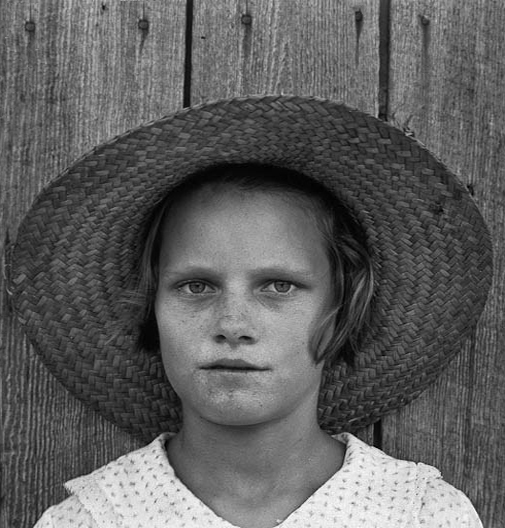
The original image from “Let us Now Praise Famous Men” from which I created the painting.
Maggie Louise was a bright girl and did well at school despite having to pick cotton to help support the family and had dreams to achieve things that would take here out of poverty. The cotton industry was failing at the time and instead of letting it collapse the government bailed it out with cash and one effect of this was to keep the tenant farmers in poverty. 50 years later another journalist Dale Maharidge went back to the area to see what had happened to the families and produced the Pulitzer prize-winning book “And Their Children After Them”. Maggie Louise had not been able to continue at school and had married at 15 and quickly became a young mother. At the age of 45 heartbroken to watch her own daughters having to do the same as she did as a child picking cotton, went out to a local hardware store, bought a bottle of rat poison and sat down and drank it committing suicide.
My interest in the image. We all have tragedy in our lives at sometimes, but I am often struck by how fortunate I have been, and the difficulty of the human existence lived by the vast number of the “ordinary” folk of humanity. This has always been something I have been drawn to. This is not to decry the heroic of this world but perhaps elevate the “ordinary” in lived lives to be the amazing thing it is.
This work is one which documents an ordinary but difficult life and is my little effort in praise of the “ordinary” and I hope that Maggie is content in the “Meadows of Asphodel”
The Meadows of Asphodel: in Greek legend the place where ordinary souls pass the afterlife.
 Asphodel Flowers.
The Oxford English Dictionary gives Homer as the source for the English poetic tradition of describing the meadows of the afterlife as being covered in Asphodel. In the translation by W. H. D. Rouse, the passage in question (from The Odyssey, Book 11) is rendered, “the ghost of clean-heeled Achilles marched away with long steps over the meadow of Asphodel.” In Book 24 in the same translation, the souls of the dead, “came to the Meadow of Asphodel where abide the souls and phantoms of those whose work is done. “Homer describes the experience of the dead souls and relates the meadow to its surroundings in these books and in Circe’s brief description at the end of Book 10. Asphodel flowers growing in the underworld is an idea that may predate Homer’s writings. (Source Wikepedia).
-

The Young Sebastian, (Oil on Voile 76cm x 111.5cm)
I have enjoyed drawing and painting the human figure in many guises throughout my career, in most cases through a loose and expressive technique. It is as pleasure to introduce “The Young Sebastian” one of my grandchildren completed in a more traditional manner.
-
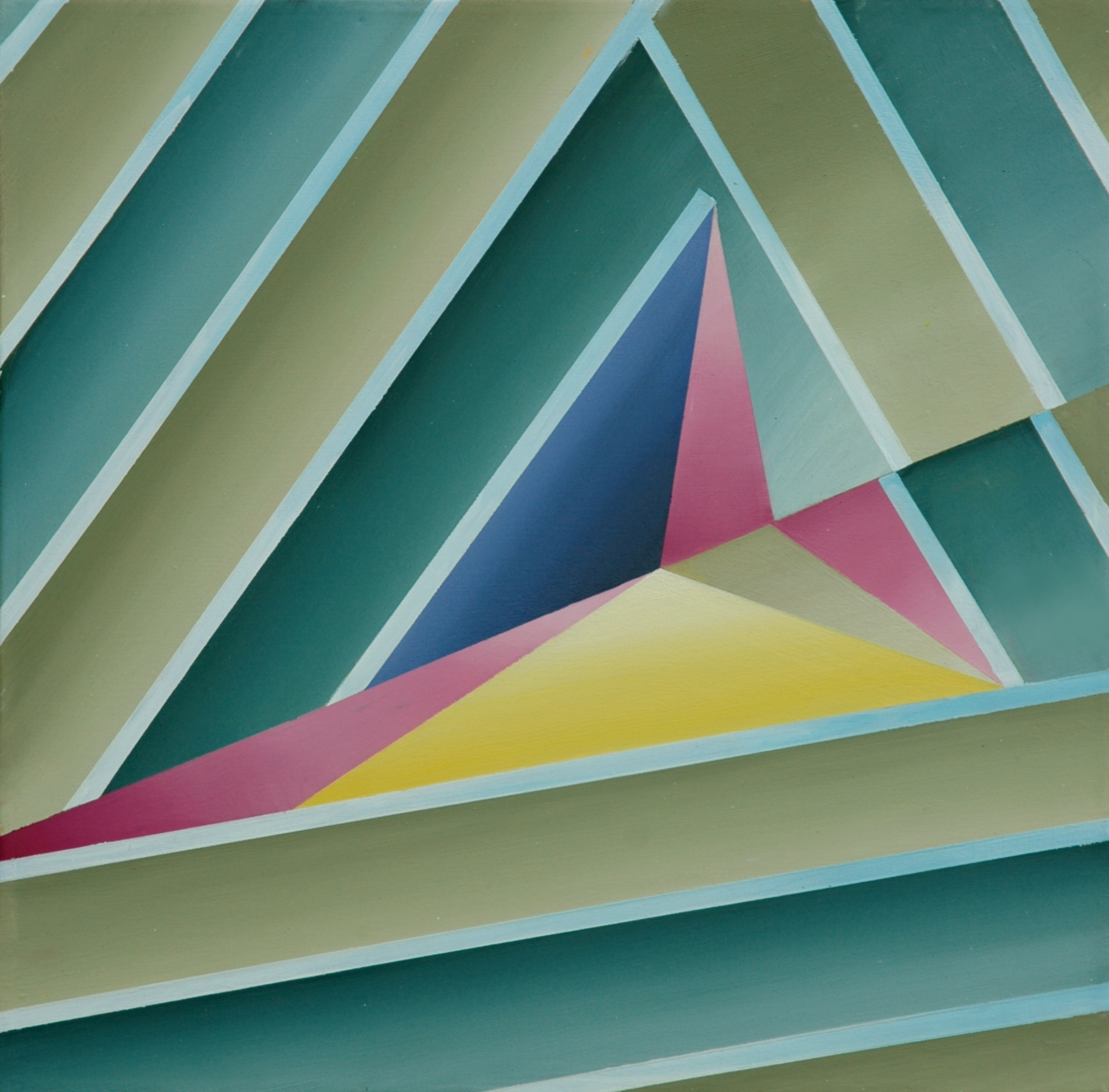
“Opus 6: Nine Point Circle!. There is no circle in this image but it was created because of a shearing effect determined by two of the points in “the Nine Point Circle” that can be found in every triangle. “Nine Point Circle”
There is no circle visible in this work but the shearing of the triangle was made using two of the points from the nine point circle.
The Circle Explanation:
The nine point circle is a mathematical phenomenon sometimes referred to as Feuerbach’s Circle, Euler’s circle, Terquem’s circle. Every Triangle has within it and through it a nine point circle.
The nine-point circle is a circle that can be constructed for any given triangle. It is so named because it passes through nine significant concyclic points defined from the triangle. These nine points are:
- The midpoint of each side of the triangle.
- The foot of each altitude.
- The midpoint of the line segment from each vertex of the triangle to the orthocenter (where the three altitudes meet; these line segments lie on their respective altitudes).

Feuerbach’s Circle
Not being a mathematician that’s the best I can do with the technical explanation. The following are my thoughts on making the work.
My thoughts that gave birth to the work:
“The cradle rocks above an abyss, and common sense tells us that our existence is but a brief crack of light between two extremities of darkness” this is the opening sentence from Vladimir Nabokov‘s book “Speak, Memory”.
Two paradox’s of my comprehension gave birth to this work and others in the “Opus” series. The first is the idea that the infinite behind me is the same as the infinite in front of me as I move from one to the other and the second is that as some scientists think time did not exist before the “Big Bang”, although theories change all the time. No pun intended!
The two extremities of darkness for me are both infinite, and the small crack of light that is my life I am moving through, so the infinity behind me should be getting bigger and the one in front of me smaller but I am told that the infinite is always the same so can the one behind me remains the same as I get further away from it, no matter how miniscule in the universal eternity that may be.
I am vaguely aware that some scientists say before the “Big Bang” time did not exist but I can’t comprehend that, before the “Big Bang” the entire matter that makes up the universe was supposedly the size of a pea, and in my mind no matter how small anything is it needs space to exist and if it exists there must be duration and so there was always what I would consider time.
Now at this stage many scientist’s and cosmologist’s will be tearing their hair out at my ramblings but these thought whether right or wrong give rise to my thoughts and imaginings and the universe is realized through the thoughts and imaginings of humanity.
These paradox made me wonder therefore if the “Nine Point Circle” existed before the Big Bang or was the theoretical phenomenon of life born with the physical. In my mind they must always have existed, but then my mind doesn’t half come up with some strange and wild imaginings every now and then, so reader beware!
So here is the simple premise for the work, I created a random triangle which can still be seen, created the nine point circle and using two of the nine points sheared the triangle on those points and then moving out created the pattern which I then painted. The spacing and colour in the work apart from the shearing distance are completely intuitive and so that aspect of the work mirrors the idea of the universe being imagined by humanity, whilst the pattern is the creation of something that has always existed imagined by myself.
 Malcolm Tait, Artist and Maker